
09 Nov Letter to Robert Menendez – Chairman, Committee on Foreign Relations

November 5, 2021
The Honorable Robert Menendez
Chairman, Committee on Foreign Relations
The United States Senate
Washington, DC 20510
Dear Senator Menendez,
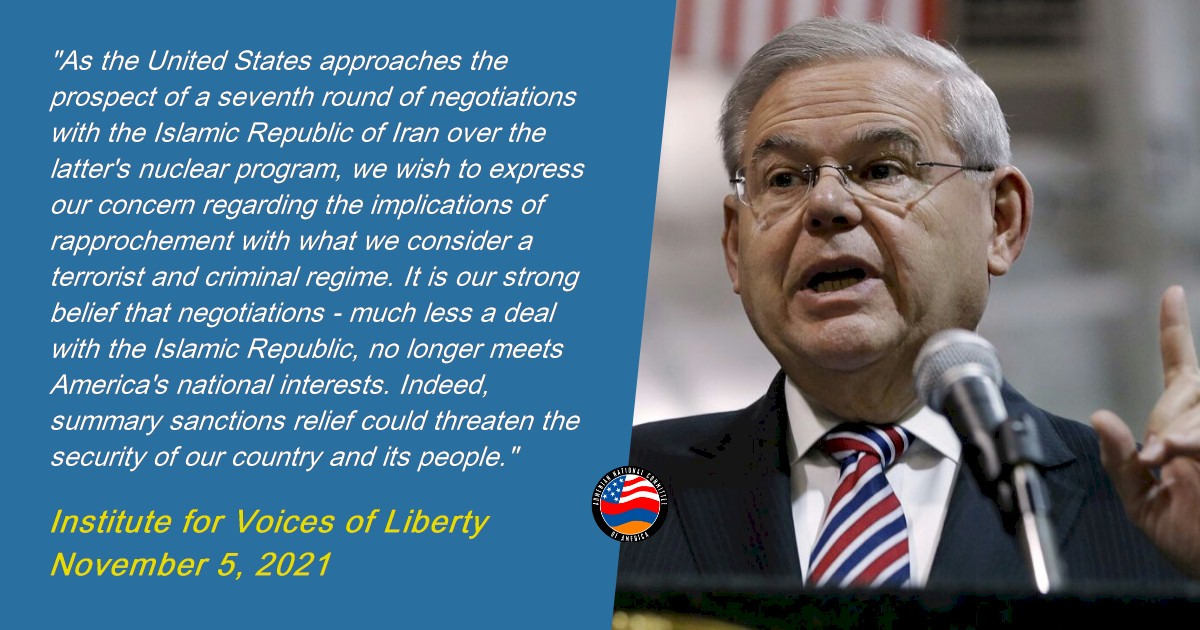
As the United States approaches the prospect of a seventh round of negotiations with the Islamic Republic of Iran over the latter’s nuclear program, we wish to express our concern regarding the implications of rapprochement with what we consider a terrorist and criminal regime. It is our strong belief that negotiations — much less a deal with the Islamic Republic, no longer meets America’s national interests. Indeed, summary sanctions relief could threaten the security of our country and its people.
There are facts that corroborate this perspective and we wish to bring them to your attention.
- The Islamic Republic has grown its nuclear activities to a threshold at which a snapback return to the 2015 Joint Comprehensive Plan of Action (JCPOA) is unrealistic, if not impossible, to address the proliferation concerns. The nuclear deal’s nonproliferation mandates are now unrecoverable without major changes to the accord. According to a September 2021 report by the International Atomic Energy Agency (IAEA), the regime in Tehran has quadrupled its stockpile of 60 percent-enriched uranium since May 2021.1 In addition, the Islamic Republic has begun using advanced centrifuges, known as the IR9, which are 50 times more powerful at producing enriched uranium than the ones covered by the JCPOA.2 Whether the regime is even willing to backtrack on these advancements is unknown. It is entirely probable that the Islamic Republic would try to leverage its nuclear violations for greater concessions from the United States.
- The JCPOA’s “sunset” clauses will provide the opportunity for the Islamic Republic to manufacture nuclear weapons in 10 years, perhaps even sooner. After 2031, there are no provisions that prevent the Islamic Republic from producing and stockpiling weapon-grade uranium.3
- The regime in Iran is unwilling to compromise on matters other than its nuclear program, including sponsorship and export of international terrorism, destabilizing behavior in the Middle East, human rights violations and its arsenal of ballistic missiles. In fact, barring the lifting of all sanctions – including those imposed by the United States Congress – the Islamic Republic is perhaps also disinclined to downgrade its nuclear program. Therefore, the State Department’s pursuit of a longer and stronger deal is implausible. In a June 2021 press conference, the Islamic Republic’s president Ebrahim Raisi clearly stated that the regime’s ballistic missiles and regional policies are “not negotiable.”4 He also said last month when addressing the United Nations General Assembly that the Islamic Republic considers negotiations useful only when the ultimate outcome is the lifting of all United States sanctions.5
- The Islamic Republic is too unreliable for the United States to enter an accord with. In 2019, Israel exposed the regime’s covert nuclear weapons program that was in violation of the JCPOA, as well as the Non-Proliferation Treaty.6 In addition, the Islamic Republic recently reneged on its commitment to the IAEA. The regime reached an agreement with the United Nations nuclear watchdog on September 12, 2021 to allow inspectors to service and replace surveillance equipment and storage media at all necessary locations in Iran, including TESA Karaj centrifuge component manufacturing workshop.7Two weeks later, the Islamic Republic repudiated the agreement by refusing to allow inspectors to access the Karaj complex.8
- Easing sanctions on the Islamic Republic will help finance its criminal activities in other areas. During his confirmation hearings before the Islamic Parliament, regime’s Foreign Minister Hossein Amir-Abdollahian stated that his ministry will unconditionally support the “Axis of Resistance” against the presence of world powers in the Middle East.9 The Axis of Resistance essentially consists of proxy militia groups in the region including Hezbollah, Hamas, Islamic Jihad, the Houthis, and various terror factions in Iraq. Ali Akbar Velayati, senior adviser to Supreme Leader Ali Khamenei in international affairs, has stated that the Taliban is also a part of the Axis of Resistance.10 The regime has also significantly expanded its drone technology.11 Unmanned aircrafts manufactured by the Islamic Republic have been used by Hamas to attack Israeli civilians, by the Houthis to strike Saudi refineries, and by the regime itself targeting United States military bases in Iraq.12,13,14 In July 2021, an Israeli merchant vessel was attacked in the Arabian Sea, killing two innocent people. Drone fragments recovered from the damaged tanker proved the Islamic Republic was behind the incident.15
- The Islamic Republic is a key perpetrator of global cyber terrorism. According to a 2019 report by the Center for Strategic and International Studies, hackers hired by the regime targeted more than 170 universities around the world, stealing $3.4 billion worth of intellectual property.16 They have also attacked current and former United States government officials, journalists and Iranian dissidents living abroad.16 In addition, the Islamic Republic launched cyber-attacks against 200 oil and gas companies, the telecom and travel industries, financial firms in the United States, and the flood control system of a dam in Rye Brook, New York.17
- The Islamic Republic continues with the practice of hostage-taking in order to use the victims as bargaining chips for international transactions. Currently, three Americans and one United States permanent resident are in detention inside the regime’s notorious penitentiaries.18 All of these individuals were detained by the regime after the JCPOA’s enactment and during the government of the so-called “moderate” president, Hassan Rouhani.
- The Islamic Republic is complicit in criminal activities inside the United States. In July 2021, a plot to abduct a New York-based Iranian-American journalist and women’s rights activist was foiled by the Federal Bureau of Investigation.19 Four individuals linked to the Islamic Republic’s Ministry of Intelligence were charged by the United States Justice Department for their role in the kidnapping plot.19
Based on its past and present conduct, we believe the Islamic Republic will violate the terms of any future accord with the United States. Even if it symbolically stays committed to a nuclear deal, the regime will escalate its malign behavior on other fronts. In actuality, the regime’s intent is using the rapid expansion of its nuclear program to distract the United States and the international community from other criminal operations in which it is involved. The “cat and mouse” game the Islamic Republic is currently playing with respect to returning to the negotiating table is merely a ploy to buy time, thereby demanding additional concessions from the United States. Recently for example, Mr. Amir-Abdollahian tried to extort a $10 billion ransom from the United States in exchange for returning to nuclear negotiations.
Re-entering the JCPOA by the United States would be harmful to America’s nonproliferation objectives. Negotiations with a deceptive regime whose raison d’être is hostility and malice towards America and its allies is futile, irrespective of the outcome.
We respectfully request that the Senate and particularly the Committee on Foreign Relations objectively and seriously assess the merits of further negotiations with the Islamic Republic and oversee the process of engagement with the Tehran regime. The Senate Committee on Foreign Relations should use its authority to challenge any policy and diplomatic approach that is deemed counterproductive and harmful to the interests of the United States and its allies.
We appreciate your attention to this critical matter.
Sincerely yours,
Institute for Voices of Liberty
REFERENCES
- “UN watchdog: Iran has quadrupled its stocks of 60%-enriched uranium since May.” Times of Israel. September 7, 2021.
Available at:
- “Iran Spins More Centrifuges on US Embassy Crisis Anniversary” Associated Press. November 4, 2019.
Available at:
- “Key Sunsets under the JCPOA and UNSC Resolution 2231.” Foundation for Defense of Democracies. February 24, 2021.
Available at:
https://www.fdd.org/analysis/2021/02/19/key-sunsets-under-the-jcpoa-and-unsc-resolution-2231/
- “Raisi says Iran’s ballistic missiles are ‘not negotiable’ — and he doesn’t want to meet Biden.” Washington Post. June 21, 2021.
Available at:
https://www.washingtonpost.com/world/2021/06/21/iran-nuclear-power-plant-bushehr/
- “Iran wants nuclear talks that lead to lifting of U.S. sanctions, president says.” Reuters. September 21, 2021.
Available at:
- “Prime Minister Benjamin Netanyahu on Iran’s Nuclear Program.” Israel Ministry of Foreign Affairs Website. September 9, 2019.
Available at:
- “Iran and IAEA Reach Last Deal on Nuclear Monitoring.” New York Times. September 12, 2021.
Available at:
https://www.nytimes.com/2021/09/12/world/europe/iran-iaea-nuclear-deal.html
- “Iran Fails to Fully Honour Agreement on Monitoring Equipment.” Reuters. September 26, 2021.
Available at:
- “AmirAbdollahian: We Will Firmly Defend the Axis of Resistance.” Al Mayadeen. August 22, 2021.
Available at:
- “Leader’s Top Advisor: US Not Able to Return to Iraq, Afghanistan Again.” Fars News Agency. August 25, 2021.
Available at:
- “Iran’s Armed-Drone Prowess Reshapes Security in the Middle East.” Wall Street Journal. October 6, 2021.
Available at:
https://www.wsj.com/articles/irans-armed-drone-prowess-reshapes-security-in-middle-east-11633530266
- “Iran’s Hand Seen in Hamas Drone Threat against Israel – Analysis.” Jerusalem Post. May 15, 2021.
Available at:
- “Drone Strike on Riyadh Oil Refinery Claimed by Houthis Causes Fire.” Reuters. March 19, 2021.
Available at:
https://www.reuters.com/article/saudi-security-yemen-int-idUSKBN2BB19Q
- “Iran-Backed Militias Turn to Drone Attacks, Alarming US Forces in Iraq.” Washington Post. May 29, 2021.
Available at:
- “US Says Drone Fragments Recovered from Israeli-Linked Tanker Point to Iran’s Role in the Attack.” Wall Street Journal.August 6, 2021.
Available at:
https://www.wsj.com/articles/g-7-eu-blame-iran-for-attack-on-mercer-street-merchant-ship-11628266491
- “Publicly Reported Iranian Cyber Actions in 2019.” Center for Strategic & International Studies Website. 2019.
Available at:
https://www.csis.org/programs/technology-policy-program/publicly-reported-iranian-cyber-actions-2019
- “Should the US Consider Iran’s ‘Deniable’ Attacks A Significant Threat?” The Hill. October 6, 2021.
Available at:
- “Iran, Hostages and Déjà Vu – Biden Needs to Do Better.” The Hill. February 27, 2021.
Available at:
https://thehill.com/opinion/international/540823-iran-hostages-and-deja-vu-biden-needs-to-do-better
- “Not Some Far-Fetched Movie Plot: 4 Iranians Accused of Plotting to Kidnap Masih Alinejad in Brooklyn.” USA Today.July 14, 2021.
Available at: